

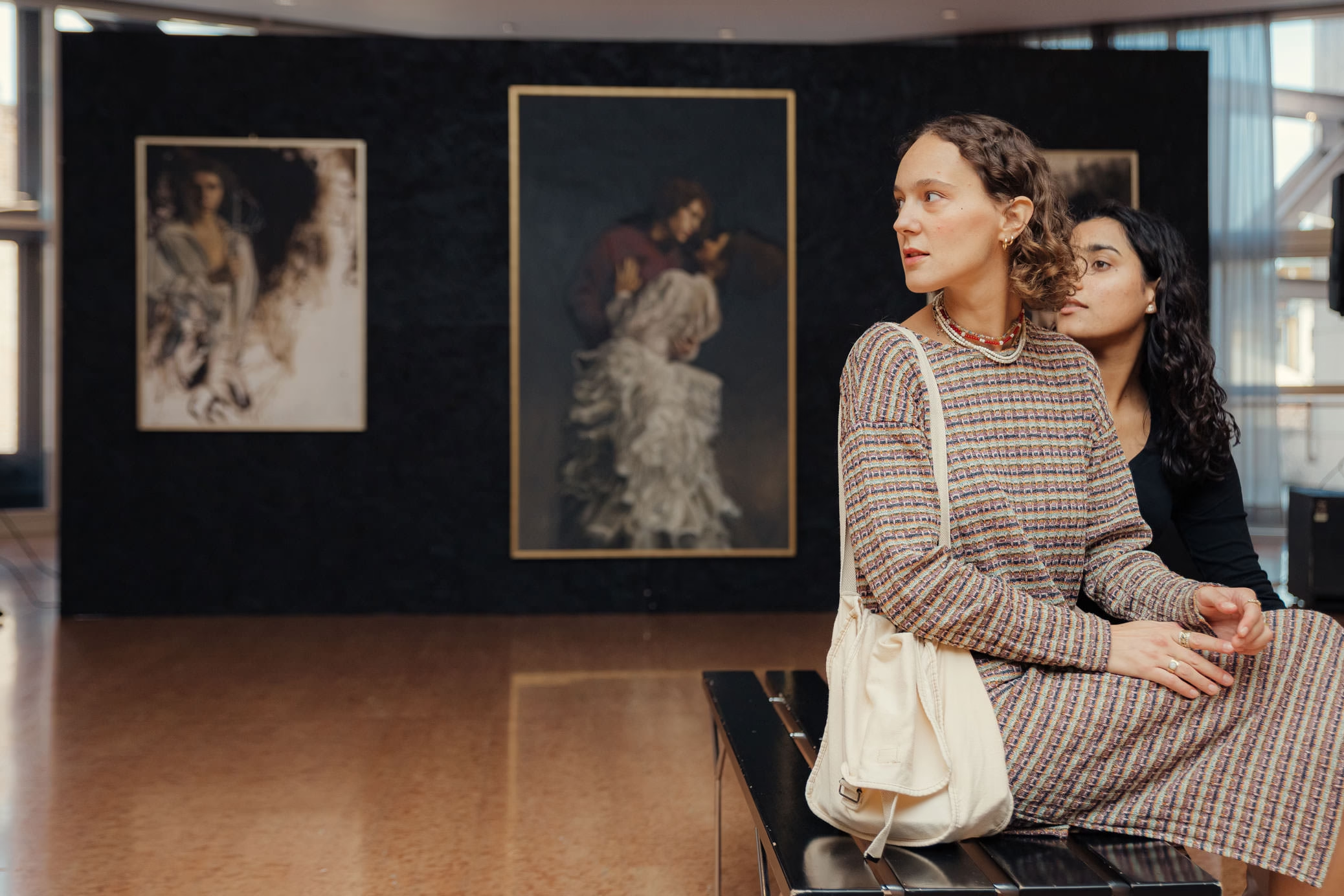
Can a Painting Help Heal a Relationship?
There are paintings that tell a story, and there are paintings that ask us to look at our own lives.
Polaris, one of the central works in Alex Righetto’s Romeo and Juliet: The Metamorphosis collection, belongs to the second kind.
What is Romeo & Juliet: The Metamorphosis
“Romeo and Juliet: The Metamorphosis” is a multimedia art project that reinterprets the story of Romeo and Juliet through a contemporary narrative, bringing together painting, cinema, storytelling, and digital media.
The project explores the relationship between technology, communication, and human connection, examining how contemporary society shapes the way we relate to one another. At the heart of the story is the individual’s journey of transformation: a passage from selfishness and isolation toward awareness, empathy, and a deeper understanding of others.
Through this journey, Shakespeare’s tragedy becomes a starting point for a reflection on the present and on the possibility of transforming personal crisis into an opportunity for rebirth.
Polaris: At the Heart of the Collection
At first glance, the painting appears deeply romantic, perhaps even idealized. It presents an image of love that may seem almost too perfect, and perhaps even a little stereotypical.
When people enter a relationship, they often create an image in their minds of what that relationship could become. They imagine how they will look at one another, how they will care for each other, and who they hope to become together.
The difficult part comes later.
As time passes, everyday life takes over. Responsibilities grow. Difficulties arise. Communication can become more complicated. And, sometimes, the way two people look at each other begins to change.
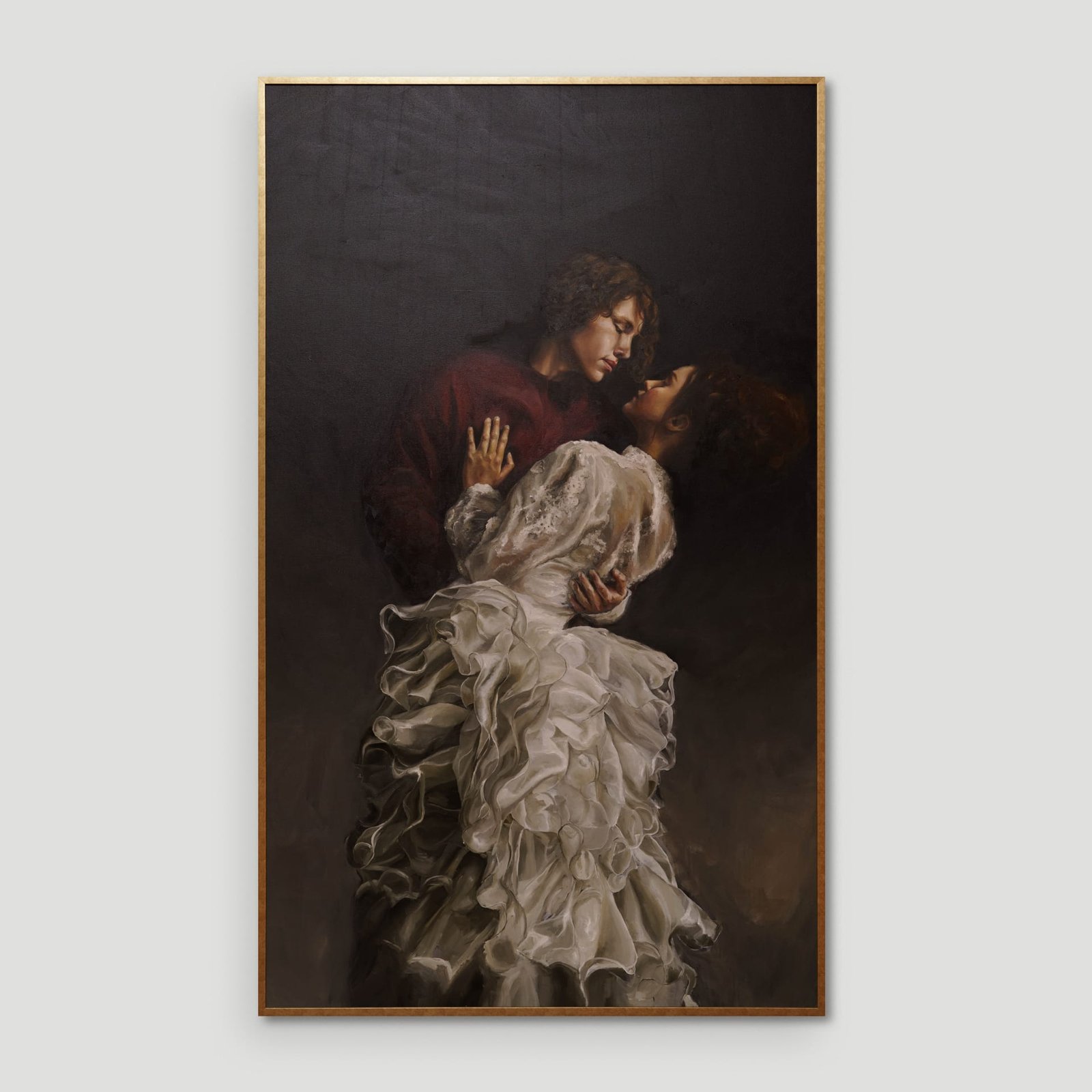
The question then becomes: how difficult is it to preserve that original vision?
How difficult is it to remember the relationship one wanted to build, even when reality becomes more complicated?
For Righetto, this is precisely what Polaris represents.
The painting is an invitation to remember what a relationship can be. Perhaps the image is idealistic. Perhaps it is even impossible to reach completely.
But an ideal does not necessarily have to be reached in order to have meaning.
It can simply serve as a point of reference.
Something that can be recreated every day. Something that must be recreated every day. Something that must continue to be imagined.This is the reason for the painting’s title: Polaris, the North Star.
For centuries, sailors looked to the North Star to orient themselves when they were surrounded by darkness and had no instruments to guide them.
Polaris did not necessarily tell them their destination.
It gave them a direction.
In the same way, Righetto sees Polaris as a reference point for a couple: something to look toward when they lose their way, something to remember when things become difficult, and an image of the relationship they want to continue building together.
Perhaps art cannot heal a relationship by itself.
But it can remind two people of something they may have forgotten.
It can give them an image of what they once imagined, and perhaps inspire them to recreate it again.
Every day.

A limited edition print of this painting is now available.
The original artwork is not available, but this limited edition is produced at full scale and presented in the original frame, with a unique, hand-painted intervention created specifically for each piece.
For information and availability, please send me a private message.
